Category Archives: Guest Bloggers

How to Business Blog Without Being Unprofessional

Writing on your blog is not gossip. While you could get plenty of traffic from your industry by spreading juicy titbits about your competitors and colleagues you will more likely grab yourself a bad reputation rather than more work or industry profile. Language can be an issue. I am not talking about swearing and such, most business people would know better than to drop bad language into a marketing tool. What I mean is tone and sophistication. You have to fit the voice to the audience. Of course I am pretty laid back here on this blog, while there are quite a few CEOs reading they tend to not be the stuffy stiff necked types (I know, I get emails from them!). You have to tune the language you use appropriately.

The best type of posts you can make, particularly in a service industry, is successful case studies.

  • What was their situation like before?
  • What were their goals or problem?
  • How did you work with them?
  • How did everything work out?

Most clients would be glad of the publicity, you just need to speak to them and get permission. Obviously some will not want specifics mentioning (particularly figures) or even to be named. That’s all fine. What matters is results and that you provide enough detail to be believable.

Talk to your clients about it and you won’t get into trouble. Going behind their backs is when you start getting into the sticky stuff.

The same is true when you want to write about exciting happenings in your own business. I imagine bloggers at Apple and Microsoft have a real hard time keeping mouths shut. There will be policies on what can and can not be talked about. If not, get some. Fast.

Many companies have footers on their emails

  • NOT to be repeated or reproduced
  • OK to email to company
  • OK to email outside company to specified individuals
  • Freely distribute

You can do the same and add a tick box for blogging if freely distribute doesn’t cover that.

Most business niches have news, tactics and events that are safe to blog about. This though is mostly filler. You can get that stuff anywhere. To make it more valuable you need to dig deep and find your hook or angle on it.

The best solution, if you haven’t already got a rich source of content to draw on, is to create some news. Could you run a competition? A survey? Interview some industry figures?

These don’t need to be massive ventures, scale to fit. While one past client of mine had a terrific success year on year with a global survey that was mentioned in television and newspapers around the world, another simply surveyed their own clients and as well as producing an excellent PR story also learned a great deal about what their customers look for and feel.

Bottom line you need to answer the question; “Could this have appeared on a competitors blog with no major changes?“. If the answer is yes you have a bland post and you need to work on it some more.

Just remember you can be interesting without being unprofessional. Focus on your reader. What is useful to them? How have you or your products helped people and businesses just like them?

Most of all, what makes you different to all the other businesses they could go to?

Visit Chris at http://www.chrisg.com/

Mentors…You Can’t Succeed Without Them!

Having a mentor is essential to your success. A mentor who has done what you want to do, has the lifestyle that you want to have and has been where you are before. Mentors have learned what works, what doesn’t work, and know the fastest and most efficient path to where they are today…They have made the mistakes…and learned what not to do…Since you want to be where they are, learning from them is like reading 1000 books on the same topic.

The reason mentors are important to have in your life is because they have the experience to guide you to your destination. They are a person to fall back on…to pick you up when you are down or are there to support you when faced with some type of adversity working to achieve your goal.

I have many mentors of my own in all different industries. They have helped me so much in showing me what books to read, how to do certain things that most people don’t know about, and really have told me, “Scott if you need anything don’t hesitate to ask.”

Knowing I have these mentors to always go to gives me peace of mind as I head into graduating next year. While most people are worried where they are going, and how they are going to get there…I personally feel like with all the mentors that I do have…I have nothing to worry about…

Now…I know nothing is going to be handed to me on a silver platter…nothing is ever that easy…but what I do know is this…If I ever need any advice, or guidance, I have the confidence in the mentors that I have to help me along the way.

So you are probably sitting there thinking….Ok Scott…You have all these mentors, but HOW DO I start building my network of mentors.

I would like to share with you what I did, starting the summer after my freshmen year.

1. The first thing that I did was write down all of the business people, and influential people that had some sort of influence over a particular industry that I knew I wanted to be involved in. I chose the industries of Real Estate, Entrepreneurship, Network Marketing, and Creative Ways Of Investing. These were contacts that my father and mother knew.

2. The second thing I did was either call them or send them an e-mail that sounded something like this. “Hi Mr. _____ I hope you are having a great day. I wanted to contact you because I know you are in ___________ industry. I think I may have an interest in being a part in that industry down the road and wanted to talk to you about your past experience in it. I know you are a very busy person, but would appreciate any time you could give me to talk about how you got to where you are today.
I am also in the process of creating a group of mentors to help and guide me along my life path and was wondering if you would have any interest in helping me in my journey.

3. After sending that e-mail I let the powers at be take control. Now you don’t have to use this e-mail word for word…even though you have my permission…but really speak from the heart when writing e-mails to those who you plan to contact.

4. The reason an e-mail like this is so key is because 1) You are being REAL with them…2)By you going to THEM and asking THEM you are stroking their ego…3)More likely than not they will want to help you because THEY KNOW exactly where you are because they have been there BEFORE.

5. When you schedule a time to get together be sure to be presentable, but comfortable at the same time. A mentor in my opinion is just a real specialized friend…you don’t have to show up in a suit…just a collared shirt or something dressy casual. I know it sounds kind of corny but thats just how I see it. When talking with them, remember my post about how people LOVE to talk about themselves. I believe it was the post about Essential Keys To Networking Effectively

Ask them everything about them…How long they have been in the industry they are in, how long they have done it, what did they do before? Etc Etc.

You will find as the conversation progresses you will be starting to ask questions like…
How did you overcome this obstacle.
What do you attribute your past success to? Do you have any guidance for me as an up and coming _____________.

What books would you reccommend that I read to help me along my journey.

Trust me they will want to help you! You just have to have enough guts to ask them.

Think about it…If you were in their position wouldn’t you want to help someone who reached out to you?

If any of you need any help whatsoever in contacting potential mentors I would be happy to help you. Just contact me by eamil at CaliforniaEagle@cox.net

How Much Time Should You Spend On Marketing?

As a solo-professional or small business owner, you have many responsibilities. Not only do you have to run your business and manage all the tasks associated with that, you also have to market that business. But just how should you divvy up your day? How much time should you spend on marketing? I believe you need to spend at least half of your time on marketing. In fact, as a business owner, I believe you really only have two main responsibilities:

1) Spending your time on revenue-producing activities

2) Marketing your business

Your time is valuable, so you shouldn’t waste it on mundane tasks that someone else could easily do.

You should be spending half your time generating income for your business. This might include things like servicing your clients and creating products.

The other half of your time should be spent on marketing to grow your business. That might include activities like writing articles and press releases, doing speaking engagements, writing and publishing an ezine or newsletter, advertising, relationship marketing, networking or Internet marketing. Any activity that is designed to bring you more clients or more sales.

But what about “all those other things” that have to get done?

All those administrative business tasks like paying bills, invoicing clients, going to the bank, picking up office supplies, fulfilling orders, monthly bookkeeping and clerical tasks like filing?

Or all of those household tasks like grocery shopping, cleaning your house, and doing laundry?

Find a way to delegate “all those other things”

…so you can focus your time on your top two priorities. If your time is worth $50 an hour or $150 an hour and you are spending it on $10 an hour tasks, it just doesn’t make sense.

What if you can’t afford to hire help?

I was in this boat for a long time myself. My mentors kept telling me to create a team and delegate. But I thought I couldn’t afford to. When I finally took the leap of faith and began assembling a team, my entire business and life changed.

I went from being a lone ranger doing everything in my businesses (yes, it was very tiring!) to a team that includes a bookkeeper, CPA, attorney, virtual assistant, writer, art director and production artist, media buyer, web developer, product manufacturer, fulfillment house, computer technician, real estate partners, property management company and others I’m sure I’m forgetting about right now.

No, I don’t have an office with all these people on staff.

I am still a “company of one.” These people are partners that I pay for specific services when I need them.

And I’ve enlisted the help of my family with the household tasks and hired housekeepers so I don’t have to spend my valuable work hours or my precious free time on these activities.

Yes, I still do some things I probably shouldn’t.

But the point is, over the past two years, I’ve learned to find experts and utilize their services to help me grow my business.

And even though I thought I couldn’t afford to hire a team…

Now I can’t imagine running my business (or my life) any other way. And paying for this help has never been an issue. Because the time they have freed up allows me to focus on my top two priorities, which has grown my businesses.

Your Marketing Step

Look around. Are you trying to do it all yourself? Are you running your business as a lone ranger? Are you spending time on activities that someone else could be doing?

If you are, I encourage you to step back and re-evaluate how your business is structured. And create a structure and a team that will allow you to spend your time on marketing and revenue-producing activities. And then watch your business grow!

Want to see how I spend my time? Visit my blog to find out!

Debbie LaChusa created The 10stepmarketing System to make marketing your own business as simple as answering 10 questions. Learn more about this unique, step-by-step system and get a free Marketing E-Course when you subscribe to the free, weekly 10stepmarketing Ezine at http://www.10stepmarketing.com

Article Source: http://EzineArticles.com/?expert=Debbie_LaChusa

Small Business Guide To Optimizing Universal Search

The buzz in the search marketing media and increasingly, the business press, on the importance of unified or universal search is gaining momentum and is unavoidable. Small and medium sized business web site owners and webmasters are now presented with the challenge of making sense out of the recent rash of search engine interface and functional improvements and how to adjust their online marketing efforts accordingly. Many are not sure what to do. Hopefully this short guide will shed light on the fundamentals and give some basic direction on next steps.

Early this summer Google rolled out one of the most significant changes to its search engine ever called Universal search. This update was followed a week or so later by Ask.com announcing Ask 3D. After a leak and then a more official announcement late September, Microsoft Live officially announced the 2.0 version of it’s search engine to include universal search features and Now Yahoo and has followed suit with their version of Unified search, being called the “new Yahoo! search“. What does all this mean for most businesses marketing online?

What is Universal Search?

First, I should explain what Google Universal, Ask 3D, Live Search and the new Yahoo! Search are, and how they’re different from the way search engines have traditionally retrieved and displayed search results. As an overview, the latest and greatest versions of the popular search engines include more than the text based web pages in the search results that we’ve all been used to the past 10+ years.

These “upgraded” search features from the major search engines now also find and bring back results in varying media formats including: images, news, local listings, video, blog posts, products and more depending on the particular search engine. But let’s break it down a bit further.

Ask and You Shall Receive

Ask 3D means bringing in three dimensions of search into one set of search results, i.e. the three columns in the search results page. For example, if you search for “Shrek 3”, on the left are additional suggested search terms and related searches to other movies. In the middle are paid listings with regular text based results below. On the right are search results from images, video, Wikipedia and other sources depending on the query.
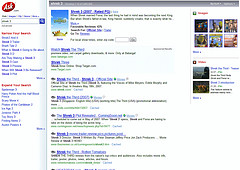

click for large view

One of the big challenges in making search a positive experience for users is to deliver the right answers according to the searcher’s intent. Searching more content sources than just web pages allows the search engine to deliver extra sets of relevant content that people may be looking for rather than making them sort through the typical web page results to find the content they’re looking for or worse, have to perform yet another search on another specific type of search engine.

Ask 3D is unique compared to Google Universal, Live Search and the new Yahoo! search because it most distinctly separates the different data sources on the page.

Google’s New Universe

Google Universal blends Images, Maps, Books, Video, and News into the standard search results page. If we use the “Shrek 3” query again as an example, you’ll see listings from YouTube mixed in with the web pages including a preview image and the option to watch the movie trailer right within the search results. Normally, you’d have to click and visit another web page to do that.
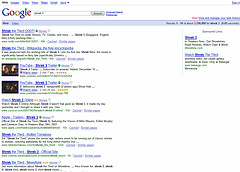

click for large view

So rather than having to perform unique queries on Google, Google News, Google Images, etc individually, Google Universal searches all of those databases and returns the best matches in one set of search results. Findings reported in a recent study by Enquiro show that searchers are more engaged with content throughout the unified search results page rather than just the top 3 listings.

That makes sense because if you search for something and see a video thumbnail in the middle of the search results page, it will draw your attention – provided the title and description text are relevant of course.

Microsoft Search is A-Live!

The new Live Search promises better relevance, speed and look/feel enhancements as well as enhanced search results for queries related to “high interest” categories like: Health, Entertainment, Shopping, Celeberaties, Local, and Video. When a search is performed, like our favorite “shrek 3”, you’ll see video thumbnails displayed near the top of the standard search results with related searches suggested on the right. One neat, and surprising to me, was that the video clips play when you put your cursor over them. No clicking necessary.


click for large view

It’s A New Yahoo

With the new Yahoo! search, the same unified search characteristics apply. Yahoo searches it’s various databases or indexes of content and brings them back into one set of search results as you can see in this “shrek 3” example search. One interesting feature is that when you search for something location/event oriented, you get a set of results at the top of the page sorted by category, date and most popular. That information comes from Yahoo site, Upcoming.org. The other more notable feature of Yahoo’s new search is the “search assist” feature that suggest phrases as you type.
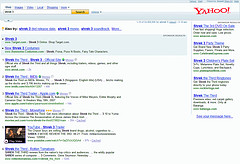

click for large view

While each version of “unified search” is slightly different, they all share the same characteristics of bringing back content from multiple data sources with the intention of providing a better user experience.

Why do these changes with the search engines matter to search marketers and web site owners?

First, it creates an online marketing challenge. A web site might have enjoyed certain positions on key terms within a search engine only now to find that their ranked web pages have been pushed down by video, image or local search results.

To address the situation, web site owners are faced with the proposition of making the effort to optimize their video, image, blog, local, news and product content. That’s easier said than done, because in most cases, small businesses have but a smattering of those content types at their disposal. If you don’t have the content format, you certainly can’t optimize for it. Even if you did, optimizing video for example, is a different thing than optimizing for news search.

The business of optimizing content for search engines just got a lot more complex.

With Challenges Come Opportunities

Many businesses won’t even notice why their search visibility has changed until it’s far into the game. Some will resort to beefing up their paid search campaigns, which you’d think might be an objective for the search engines, and some will roll up their sleeves and tackle the opportunity head on. With unified search results, there exist additional, high profile exposure opportunities where none of that type previously existed. The way for smart marketers to approach these opportunities is with a holistic perspective.

Optimizing holistically starts with an inventory of a company’s digital assets. Text, images, audio and video are all considered along with the incorporation of keyword messaging across company communications. Matching digital assets with channels of distribution provides marketers with even more opportunity to reach customers since each channel (blogging, email, media relations, social networking, forums, etc) can drive traffic independently as well as improve standard search visibility.

If a small business is not in the habit of creating content in multiple formats, then it will mean change. In fact, substantial changes may be necessary with content creation, approval and publishing processes along with the need for ongoing education. The key is to identify those content creation processes that are already occurring that could be altered or leveraged for the purpose of publishing more media content online. Process changes will still be necessary, but if a business can use some of what they’re already doing with other marketing promotions to improve their search visibility in a world of universal search, it will save effort, money and enable results more quickly.

Optimizing for Universal Search in Action

An example might be a situation where a new product is being released. In such a situation, many small businesses will post a new product page with a photo on the web site and email their list of industry publications and local reporters the announcement. They might even post a press release.

To take advantage of such a situation where unified search results can be leveraged might include the same process of updating the company web site with the product content. Such an effort would also include creating content in additional media formats, such as shooting a short video with an engineer or product manager explaining some of the features/benefits of the product. Just about all digital cameras can take a few minutes of video. The video can be edited with free video editing software like Windows Movie Maker to add credits or even add background music.

Promoting a Good Image

To leverage image search, the image file names could use keywords relevant to the product. Alt text used in the coding of the web page describing the image could do the same as well as a short text caption beneath the image. The image(s) can be submitted to image sharing web sites like Flickr.com with relevant keywords in the image category, title, description and tags. The description of the product on the image sharing site can include a link back to the product web page on the company web site.

Associating relevant keywords with the image will help media or image search engines understand what the image is, and subsequently categorize and rank it. The link from the image description on the image sharing site can send both visitors and search engines to the product page.

Video is the New Rock Star of Search

The product page on the company web site can also include the short video to give visitors another way in which to learn about the product. Embedding the video in the product web page also gives search engines another media format to index and display in unified search results. Submitting the product video to video sharing web sites such as YouTube.com with a relevant, keyword-rich description will make it even easier for the video to appear in video search and unified search results.

To take it a step further, you could upload screen captures of the video to image sharing sites and link back to the video from the description. The image and video could also be packaged with the press release to provide the media more interesting and engaging ways to learn about the new product. Submitting the press release via wire services can also leverage new search visibility. There are many more steps possible in promoting such content ranging from social bookmarking to blogger relations to the creation of viral linking campaigns, but this is a start, a foundation.

Making Universal Search Easier is Hard Work

The overall idea is to create, optimize and promote the kinds of media formats (text, images and video in this example) that both customers and search engines will respond to. Making it easy for search engines to find your text, images and video means it will be easier for those representations of your product to show up in unified search results.

It may sound like a lot of work but this is the reality of the new search. Optimizing relevant media formats to meet the information channel and format consumption preferences of customers is what will allow small businesses to continue competing against the “big guys” on the web.

The upside is that a substantial increase in media types being indexed by the new search engines all linking to a company web site will provide the kind of advantage standard search engine optimization no longer offers. In other words, optimizing for the different media types provides a competitive advantage.

The Work Will Never End But the Benefits Are Long Term

As long as there are search engines, there will be some kind of optimization for improving search engine visibility. What small business marketers need to consider are all the digital assets they have to work with and enable content creation, optimization and promotion processes to give both search engines and customers the information they’re looking for in the formats they’ll respond to.

About The Author:
Lee Odden is President and Founder of TopRank Online Marketing, specializing in organic SEO, blog marketing and online public relations. He’s been cited as a search marketing expert by publications including U.S. News & World Report and The Economist and has implemented successful search marketing programs with top BtoB companies of all sizes. Odden shares his marketing expertise at Online Marketing Blog offering daily news, interviews and best practices.

Comment or start a discussion in our forums: http://www.workconnexions.com/forums/Regional/UK.aspx

Inferno Buying The Blog Research Launch

“86% of businesses with a blog credit blogs with generating more business opportunities”

From Inferno Communications:

86% of businesses with a blog credit blogs with generating more business opportunities A significant new survey is released today showing that blogging is becoming a key business tool, providing a valuable way for companies to create new and genuine relationships with their customers. The research, carried out for UK PR agency Inferno Communications by Loudhouse Research during August 2007, polled 300 UK companies with over 250 employees. It reveals that 50% of those companies surveyed now undertake some form of blogging – either having their own blog or encouraging employees to comment on blogs.

Of those companies that do have blogs, 64% were launched in the last 6 months. And 86% of these blogging companies state that their blog has generated additional business opportunities. Blogs also compare well to other forms of business information, ranking with business decision makers as equally important as trade shows and internet searching, and more influential than TV and radio advertising.

The research questioned UK managers with direct sales and/or purchasing responsibility to discover how they and their companies use blogs to interact with existing and potential customers and how they engage with the blogosphere to inform their own business decision making. The main findings of the research found:

· 50% of UK companies now undertake some form of blogging

· 64% of UK corporate blogs have been launched in the last 6 months

· 86% of companies that have a blog credit it with generating more business opportunities for their company

· 66% of managers in the survey have visited blogs in the last 12 months

· 80% of blog users visit blogs during working hours

· 33% of blog visitors will access a blog on a daily basis

“The research shows that blogging in the UK is fast becoming a serious business tool,” Grant Currie, Managing Director of Inferno PR commented. “There are many parallels with ‘Internet 1.0’ in that there has been a lot of hype and questions asked about ‘Web 2.0’ technologies and mistakes are being made. But the fact remains that it appears blogging is one of the Web 2.0 technologies that is now taking serious hold in the business world. UK companies are now beginning to adopt blogging as part of their business strategy and those that have done so are pointing to specific business success and opportunity being created. It seems the hype is over and the real business of blogging is on its way.”

Currie also cautioned businesses to understand what is and isn’t achievable in the “blogosphere”before developing their own blogging strategies. He said, “Businesses shouldn’t view a blog as another billboard from which to shout their corporate messages. Starting a blog is essentially starting a conversation and as in verbal communication, conversations have conventions, rules and boundaries. Those businesses in our survey who have derived new business opportunities from their blogs, will have found that these successes came indirectly from the blog, rather than directly. A blog is not the place to sell and businesses should get suitable advice before embarking on their blogs.”

Prominent UK blogger, Neville Hobson, author of the Hobson Report echoes these thoughts, saying: “A business blog is a powerful communication tool, as many companies who successfully use them can attest. Blogs also represent disruptive change and a challenge to traditional business thinking. Companies who recognize the social characteristics of effective communication are those likely to gain the most from business blogging.”

The research also cautions businesses looking to exploit the blogosphere revealing significant difference in opinion between buyers and sellers over what constitutes a ‘good blog’. For instance, only 30% of respondents felt that corporate branding was a positive thing raising questions over the validity of trumpeting the company line on a blog versus allowing individual views to flourish. Furthermore, those respondents with spending responsibilities saw blogs as the second best source for informing a business
decision (behind industry reports), while those with selling responsibilities saw blogs as the least favourable source (behind industry reports, trade press and trade events).

Branding – An Ongoing Process

Branding is one of the most important issues for any business if it wants to succeed in this field of fierce competition. Branding is a very basic part of the whole marketing strategy of any business.What is a Brand?

A brand can be defined as just a set of associations that are linked to a particular company or an organization or a business group. A brand can definitely mark the corporate identity of any business. It signifies the values of the organization and its leaders. It tells about the quality of the services that are offered by the company to its customers. It tells how the company or the group differs from its competitors. Hence building a good brand image means achieving success in the business.

Fundamentals of Branding:

The branding process starts from the logo design of the organization. Logo, company name and its tag line combines to form a logo design. It is with this combination people identify your business. Hence good amount of money and time should be spent in deciding this combination. This combination should signify the mission, vision, growth plan and the values of the company. It should say how well you are going to serve your customers with your products and services. Good professionals should be used in getting some ideas on this combination. However, the top level management should take the final decision as they know the business better than any body else.

Branding Strategies:
Most of the companies start branding process even before the company starts and this process continues until the company survives in the market place. Normally all the branding campaigns will be decided by the advertising and management departments with a bit of top level management involvement. You should use the budget that has been allocated to the branding campaigns in a very intelligent manner. Never start with a huge budget campaigns unless yours is already a big brand. Spend amount sparingly in all the available advertising mediums and analyze the results from all the different mediums carefully. Have an in depth marketing mix analysis. This will show you what advertising mediums are giving you a better brand image. Then try to spend more amount on those mediums and try to analyze the possible steps you can take to better the brand visibility from the weaker mediums.
Never stop the branding process. It should go on until your business exists in the market place. If not there is a great chance of another company taking over your market share. If you follow these basic steps, it is definite that the brand image of your business will be quite healthy and it in turn brings in the required business for your company’s success.
Visit Graphic Design

About the author:
Vincent Platania
We have a professional team of graphic designers that possess artistic ability and creative thinking for designing eye catching graphic design. Visit Graphic Design

So when was the last time you said ‘Wow!” about the quality of customer service you received?

My guess is you are thinking the exact opposite, especially during the holiday break when UK civilization seems to grind to a complete halt. Perhaps you were fuming at the state of the rail network; perhaps, like me, you are waiting for your dentist to amble back to work; you might even be still be waiting for some ‘internet-enabled’ Christmas presents to be delivered.

You have two alternatives in the face of these broken promises. One is to slump into a Victor Meldrew-like state of resigned desperation and look for an alternative supplier, if you can even be bothered. The other is to consider the glass to be half full, and regard your short-term misery as a new business opportunity.

This is the natural behaviour of the serial entrepreneur. If you solve the problem, as Del Boy Trotter in Only Fools and Horses famously put it, “this time next year we’ll be millionaires”. Of course few of us are going to rush off and buy a rail franchise or become a dentist, but perhaps you might now be considering your own an internet-based business, with reliable delivery. The barrier to entry for this last kind of enterprise is relatively small, and there are plenty of people already doing very successfully in their own niche markets; you might even know one, who can give you some pointers.

What you can definitely all do in 2008 is put the ‘Wow!’ back into your existing businesses, even if you are just an employee. This is the manifesto of the inimitable Paul Dunn, a serially successful entrepreneur based in Australia. Paul has tried to retire several times but cannot seem to stop himself getting involved in new and interesting things. He is much in demand as a speaker, and focuses on getting people and organisations to improve their products and services, so that, at the end of the experience, the customer says “Wow!”

This is far too important to leave just in the hands of your marketing department. However big your company, people do buy from people, and customer service problems typically revolve around poorly trained members of staff, not your carefully thought out business processes. The upside is that all the best ideas for improving your ‘Wow!’ factor will actually come from the same pool of talent.

In small companies (which we define in our Beermat model to be less than thirty employees) there is rarely a problem. The tribal nature of the organisation lends itself to regular social gatherings, where all sorts of crazy ideas are kicked around. The skill is in filtering all these ideas and deciding on the ones that will really make a difference.

In larger companies there is a paradox. A structured organisation requires processes and rules, and these are the natural enemies of innovation. I have run many workshops in large companies instilling ‘the entrepreneurial mindset’, and it is sometimes an uphill struggle. Common complaints from the delegates are “nobody actually listens to us” and “we can’t make a difference”, so the first part of the session involves getting everyone motivated and explaining that good ideas come from anybody and everybody, not just the extroverts, the noisy ones.

We are all creative in different ways; in fact, the best new business ideas often come from the quiet ones in the room, who observe, reflect and consider before making their contribution. The skill in running such a workshop is making sure these people get heard.

When people do come up with plausible ideas, I suggest that they try them first in ‘stealth mode’, backed up by an internal sponsor, a senior person in their company who can cover their back, if necessary. The mantra for entrepreneurship in large companies is “never ask for permission, only ask for forgiveness afterwards”.

Alternatively, you can always take that great idea and run with it yourself; maybe 2008 will indeed be your big year, after all. If you have identified a problem out there, all you need to get started is the passion to solve it, your own ‘Wow!’

I asked Paul Dunn about his own personal “Wow!” It’s ‘Buy One, GIVE One Free’, a simple concept. What if every time a Plasma TV was sold, a blind person got the gift of sight? What if every time a book was sold, a tree was planted? What if every time someone dined out, a hungry kid was fed?

Buy1GIVE1Free – now better known as B1G1 – is actually transforming our world. And you can see precisely how it works by taking a look at http://www.youtube.com/buy1give1free . It’s very inspiring. Or to put it more simply: Wow!

You can find 'Buy One Give One Free' here: http://www.B1G1.com