The buzz in the search marketing media and increasingly, the business press, on the importance of unified or universal search is gaining momentum and is unavoidable. Small and medium sized business web site owners and webmasters are now presented with the challenge of making sense out of the recent rash of search engine interface and functional improvements and how to adjust their online marketing efforts accordingly. Many are not sure what to do. Hopefully this short guide will shed light on the fundamentals and give some basic direction on next steps.
Early this summer Google rolled out one of the most significant changes to its search engine ever called Universal search. This update was followed a week or so later by Ask.com announcing Ask 3D. After a leak and then a more official announcement late September, Microsoft Live officially announced the 2.0 version of it’s search engine to include universal search features and Now Yahoo and has followed suit with their version of Unified search, being called the “new Yahoo! search“. What does all this mean for most businesses marketing online?
What is Universal Search?
First, I should explain what Google Universal, Ask 3D, Live Search and the new Yahoo! Search are, and how they’re different from the way search engines have traditionally retrieved and displayed search results. As an overview, the latest and greatest versions of the popular search engines include more than the text based web pages in the search results that we’ve all been used to the past 10+ years.
These “upgraded” search features from the major search engines now also find and bring back results in varying media formats including: images, news, local listings, video, blog posts, products and more depending on the particular search engine. But let’s break it down a bit further.
Ask and You Shall Receive
Ask 3D means bringing in three dimensions of search into one set of search results, i.e. the three columns in the search results page. For example, if you search for “Shrek 3”, on the left are additional suggested search terms and related searches to other movies. In the middle are paid listings with regular text based results below. On the right are search results from images, video, Wikipedia and other sources depending on the query.
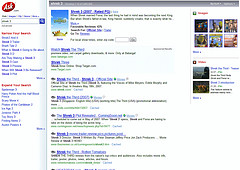
click for large view
One of the big challenges in making search a positive experience for users is to deliver the right answers according to the searcher’s intent. Searching more content sources than just web pages allows the search engine to deliver extra sets of relevant content that people may be looking for rather than making them sort through the typical web page results to find the content they’re looking for or worse, have to perform yet another search on another specific type of search engine.
Ask 3D is unique compared to Google Universal, Live Search and the new Yahoo! search because it most distinctly separates the different data sources on the page.
Google’s New Universe
Google Universal blends Images, Maps, Books, Video, and News into the standard search results page. If we use the “Shrek 3” query again as an example, you’ll see listings from YouTube mixed in with the web pages including a preview image and the option to watch the movie trailer right within the search results. Normally, you’d have to click and visit another web page to do that.
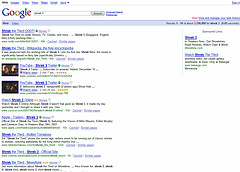
click for large view
So rather than having to perform unique queries on Google, Google News, Google Images, etc individually, Google Universal searches all of those databases and returns the best matches in one set of search results. Findings reported in a recent study by Enquiro show that searchers are more engaged with content throughout the unified search results page rather than just the top 3 listings.
That makes sense because if you search for something and see a video thumbnail in the middle of the search results page, it will draw your attention – provided the title and description text are relevant of course.
Microsoft Search is A-Live!
The new Live Search promises better relevance, speed and look/feel enhancements as well as enhanced search results for queries related to “high interest” categories like: Health, Entertainment, Shopping, Celeberaties, Local, and Video. When a search is performed, like our favorite “shrek 3”, you’ll see video thumbnails displayed near the top of the standard search results with related searches suggested on the right. One neat, and surprising to me, was that the video clips play when you put your cursor over them. No clicking necessary.

click for large view
It’s A New Yahoo
With the new Yahoo! search, the same unified search characteristics apply. Yahoo searches it’s various databases or indexes of content and brings them back into one set of search results as you can see in this “shrek 3” example search. One interesting feature is that when you search for something location/event oriented, you get a set of results at the top of the page sorted by category, date and most popular. That information comes from Yahoo site, Upcoming.org. The other more notable feature of Yahoo’s new search is the “search assist” feature that suggest phrases as you type.
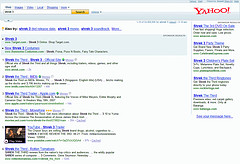
click for large view
While each version of “unified search” is slightly different, they all share the same characteristics of bringing back content from multiple data sources with the intention of providing a better user experience.
Why do these changes with the search engines matter to search marketers and web site owners?
First, it creates an online marketing challenge. A web site might have enjoyed certain positions on key terms within a search engine only now to find that their ranked web pages have been pushed down by video, image or local search results.
To address the situation, web site owners are faced with the proposition of making the effort to optimize their video, image, blog, local, news and product content. That’s easier said than done, because in most cases, small businesses have but a smattering of those content types at their disposal. If you don’t have the content format, you certainly can’t optimize for it. Even if you did, optimizing video for example, is a different thing than optimizing for news search.
The business of optimizing content for search engines just got a lot more complex.
With Challenges Come Opportunities
Many businesses won’t even notice why their search visibility has changed until it’s far into the game. Some will resort to beefing up their paid search campaigns, which you’d think might be an objective for the search engines, and some will roll up their sleeves and tackle the opportunity head on. With unified search results, there exist additional, high profile exposure opportunities where none of that type previously existed. The way for smart marketers to approach these opportunities is with a holistic perspective.
Optimizing holistically starts with an inventory of a company’s digital assets. Text, images, audio and video are all considered along with the incorporation of keyword messaging across company communications. Matching digital assets with channels of distribution provides marketers with even more opportunity to reach customers since each channel (blogging, email, media relations, social networking, forums, etc) can drive traffic independently as well as improve standard search visibility.
If a small business is not in the habit of creating content in multiple formats, then it will mean change. In fact, substantial changes may be necessary with content creation, approval and publishing processes along with the need for ongoing education. The key is to identify those content creation processes that are already occurring that could be altered or leveraged for the purpose of publishing more media content online. Process changes will still be necessary, but if a business can use some of what they’re already doing with other marketing promotions to improve their search visibility in a world of universal search, it will save effort, money and enable results more quickly.
Optimizing for Universal Search in Action
An example might be a situation where a new product is being released. In such a situation, many small businesses will post a new product page with a photo on the web site and email their list of industry publications and local reporters the announcement. They might even post a press release.
To take advantage of such a situation where unified search results can be leveraged might include the same process of updating the company web site with the product content. Such an effort would also include creating content in additional media formats, such as shooting a short video with an engineer or product manager explaining some of the features/benefits of the product. Just about all digital cameras can take a few minutes of video. The video can be edited with free video editing software like Windows Movie Maker to add credits or even add background music.
Promoting a Good Image
To leverage image search, the image file names could use keywords relevant to the product. Alt text used in the coding of the web page describing the image could do the same as well as a short text caption beneath the image. The image(s) can be submitted to image sharing web sites like Flickr.com with relevant keywords in the image category, title, description and tags. The description of the product on the image sharing site can include a link back to the product web page on the company web site.
Associating relevant keywords with the image will help media or image search engines understand what the image is, and subsequently categorize and rank it. The link from the image description on the image sharing site can send both visitors and search engines to the product page.
Video is the New Rock Star of Search
The product page on the company web site can also include the short video to give visitors another way in which to learn about the product. Embedding the video in the product web page also gives search engines another media format to index and display in unified search results. Submitting the product video to video sharing web sites such as YouTube.com with a relevant, keyword-rich description will make it even easier for the video to appear in video search and unified search results.
To take it a step further, you could upload screen captures of the video to image sharing sites and link back to the video from the description. The image and video could also be packaged with the press release to provide the media more interesting and engaging ways to learn about the new product. Submitting the press release via wire services can also leverage new search visibility. There are many more steps possible in promoting such content ranging from social bookmarking to blogger relations to the creation of viral linking campaigns, but this is a start, a foundation.
Making Universal Search Easier is Hard Work
The overall idea is to create, optimize and promote the kinds of media formats (text, images and video in this example) that both customers and search engines will respond to. Making it easy for search engines to find your text, images and video means it will be easier for those representations of your product to show up in unified search results.
It may sound like a lot of work but this is the reality of the new search. Optimizing relevant media formats to meet the information channel and format consumption preferences of customers is what will allow small businesses to continue competing against the “big guys” on the web.
The upside is that a substantial increase in media types being indexed by the new search engines all linking to a company web site will provide the kind of advantage standard search engine optimization no longer offers. In other words, optimizing for the different media types provides a competitive advantage.
The Work Will Never End But the Benefits Are Long Term
As long as there are search engines, there will be some kind of optimization for improving search engine visibility. What small business marketers need to consider are all the digital assets they have to work with and enable content creation, optimization and promotion processes to give both search engines and customers the information they’re looking for in the formats they’ll respond to.
About The Author:
Lee Odden is President and Founder of TopRank Online Marketing, specializing in organic SEO, blog marketing and online public relations. He’s been cited as a search marketing expert by publications including U.S. News & World Report and The Economist and has implemented successful search marketing programs with top BtoB companies of all sizes. Odden shares his marketing expertise at Online Marketing Blog offering daily news, interviews and best practices.
Comment or start a discussion in our forums: http://www.workconnexions.com/forums/Regional/UK.aspx


