Category Archives: Uncategorized

Dyslexia and Work

A couple of years ago a boss of mine pointed out that dyslexia is just another word for laziness. In some ways he is right, it is often perceived as being lazy. His argument was that he had overcome dyslexia by working hard. For some milder cases this is very possible. How can people live with dyslexia and what can companies do to help, or more importantly how do individuals help themselves.

A very good example of dealing with dyslexia  is demonstrated by Richard Branson. He suffers from not just word dyslexia but also number dyslexia. To quote Mr Branson. ‘Nothing is impossible if you surround yourself with the right people’. This was his solution to the problem.  What I think is very interesting in this story. Is that he is probably the biggest Marketing asset Virgin have. In my view, while Richard Branson might not be the world’s number one speller he has quite clearly other qualities. In the present business atmosphere we tend to look very much towards written qualifications. Which means that a lot companies have very little diversity.

Why is diversity important? Diversity is strength. This is best explained in the following situation. If you have a computer network all machines running on identical systems and a virus gets into the system, you can guarantee that every one of those computers will get infected. If you have a network network running on several different systems, it is not possible for one computer virus to bring down the entire network. Companies are much the same. Diversity makes a company stronger and more able to meet the challenges it faces.

Emotional intelligence is not generally recognised as there is no real way to grade it. But it is a very important skill. When companies are thinking about a specific role, they may have to think more about teams. What is going to diverse the team? What is going to make it stronger?

I am not sure where this quote is from but it is very relevant to the situation: ‘If everyone is thinking the same, then somebody is not thinking’.

Building teams is a complicated process. But it is the most beneficial where the different individuals complement each other  and are recognised for it.

25 years on Manx Tails

This month we see an anniversary of a local publication on the Isle of Man that has managed to survive 25 years. No mean feat for any magazine in this day and age. How has it managed to do this? There are several contributing factors to this in this blogger opinion. On the Isle of Man we enjoy a rather small population, which means that competition is not really possible. There may be only room for one magazine. As effectively there are at least nine advertising outlets for businesses (radio, papers, websites) to choose from, everyone is competing for a slice of the pie. So one would imagine that the product would have be really good. For a free magazine it certainly fulfills its market. It is hard to speculate just how successful the magazine is as the company is privately owned. But is has been around for a long time. I am interested in other peoples thoughts about advertising and magazines in general on the Isle of Man.

The Top Ten Lies of Entrepreneurs

Guy Kawasaki writes: “Since I’ve antagonized the venture capital community with last week’s blog, I thought I would complete the picture and “out” entrepreneurs to begin this week. The hard part about writing this blog was narrowing down these lies to ten.” “I get pitched dozens of times every year, and every pitch contains at least three or four of these lies. I provide them not because I believe I can increase the level of honesty of entrepreneurs as much as to help entrepreneurs come up with new lies. At least new lies indicate a modicum of creativity!”

  1. “Our projections are conservative.” An entrepreneur’s projections are never conservative. If they were, they would be $0. I have never seen an entrepreneur achieve even her most conservative projections. Generally, an entrepreneur has no idea what sales will be, so she guesses: “Too little will make my deal uninteresting; too big, and I’ll look hallucinogenic.” The result is that everyone’s projections are $50 million in year four. As a rule of thumb, when I see a projection, I add one year to delivery time and multiply by .1.
  2. “(Big name research firm) says our market will be $50 billion in 2010.” Every entrepreneur has a few slides about how the market potential for his segment is tens of billions. It doesn’t matter if the product is bar mitzah planning software or 802.11 chip sets. Venture capitalists don’t believe this type of forecast because it’s the fifth one of this magnitude that they’ve heard that day. Entrepreneurs would do themselves a favor by simply removing any reference to market size estimates from consulting firms.
  3. “(Big name company) is going to sign our purchase order next week.” This is the “I heard I have to show traction at a conference” lie of entrepreneurs. The funny thing is that next week, the purchase order still isn’t signed. Nor the week after. The decision maker gets laid off, the CEO gets fired, there’s a natural disaster, whatever. The only way to play this card if AFTER the purchase order is signed because no investor whose money you’d want will fall for this one.
  4. “Key employees are set to join us as soon as we get funded.” More often than not when a venture capitalist calls these key employees who are VPs are Microsoft, Oracle, and Sun, he gets the following response, “Who said that? I recall meeting him at a Churchill Club meeting, but I certainly didn’t say I would leave my cush $250,000/year job at Adobe to join his startup.” If it’s true that key employees are ready to rock and roll, have them call the venture capitalist after the meeting and testify to this effect.
  5. “No one is doing what we’re doing.” This is a bummer of a lie because there are only two logical conclusions. First, no one else is doing this because there is no market for it. Second, the entrepreneur is so clueless that he can’t even use Google to figure out he has competition. Suffice it to say that the lack of a market and cluelessness is not conducive to securing an investment. As a rule of thumb, if you have a good idea, five companies are going the same thing. If you have a great idea, fifteen companies are doing the same thing.
  6. “No one can do what we’re doing.” If there’s anything worse than the lack of a market and cluelessness, it’s arrogance. No one else can do this until the first company does it, and ten others spring up in the next ninety days. Let’s see, no one else ran a sub four-minute mile after Roger Bannister. (It took only a month before John Landy did). The world is a big place. There are lots of smart people in it. Entrepreneurs are kidding themselves if they think they have any kind of monopoly on knowledge. And, sure as I’m a Macintosh user, on the same day that an entrepreneur tells this lie, the venture capitalist will have met with another company that’s doing the same thing.
  7. “Hurry because several other venture capital firms are interested.” The good news: There are maybe one hundred entrepreneurs in the world who can make this claim. The bad news: The fact that you are reading a blog about venture capital means you’re not one of them. As my mother used to say, “Never play Russian roulette with an Uzi.” For the absolute cream of the crop, there is competition for a deal, and an entrepreneur can scare other investors to make a decision. For the rest of us, don’t think one can create a sense of scarcity when it’s not true. Re-read the previous blog about the lies of venture capitalists, to learn how entrepreneurs are hearing “maybe” when venture capitalists are saying “no.”
  8. “Oracle is too big/dumb/slow to be a threat.” Larry Ellison has his own jet. He can keep the San Jose Airport open for his late night landings. His boat is so big that it can barely get under the Golden Gate Bridge. Meanwhile, entrepreneurs are flying on Southwest out of Oakland and stealing the free peanuts. There’s a reason why Larry is where he is, and entrepreneurs are where they are, and it’s not that he’s big, dumb, and slow. Competing with Oracle, Microsoft, and other large companies is a very difficult task. Entrepreneurs who utter this lie look at best naive. You think it’s bravado, but venture capitalists think it’s stupidity.
  9. “We have a proven management team.” Says who? Because the founder worked at Morgan Stanley for a summer? Or McKinsey for two years? Or he made sure that John Sculley’s Macintosh could power on? Truly “proven” in a venture capitalist’s eyes is founder of a company that returned billions to its investors. But if the entrepreneur were that proven, that he (a) probably wouldn’t have to ask for money; (b) wouldn’t be claiming that he’s proven. (Do you think Wayne Gretzky went around saying, “I am a good hockey player”?) A better strategy is for the entrepreneur to state that (a) she has relevant industry experience; (b) she is going to do whatever it takes to succeed; (c) she is going to surround herself with directors and advisors who are proven; and (d) she’ll step aside whenever it becomes necessary. This is good enough for a venture capitalist that believes in what the entrepreneur is doing.
  10. “Patents make our product defensible.” The optimal number of times to use the P word in a presentation is one. Just once, say, “We have filed patents for what we are doing.” Done. The second time you say it, venture capitalists begin to suspect that you are depending too much on patents for defensibility. The third time you say it, you are holding a sign above your head that says, “I am clueless.” Sure, you should patent what you’re doing–if for no other reason than to say it once in your presentation. But at the end of the patents are mostly good for impressing your parents. You won’t have the time or money to sue anyone with a pocket deep enough to be worth suing.
  11. “All we have to do is get 1% of the market.” (Here’s a bonus since I still have battery power.) This lie is the flip side of “the market will be $50 billion.” There are two problems with this lie. First, no venture capitalist is interested in a company that is looking to get 1% or so of a market. Frankly, we want our companies to face the wrath of the anti-trust division of the Department of Justice. Second, it’s also not that easy to get 1% of any market, so you look silly pretending that it is. Generally, it’s much better for entrepreneurs to show a realistic appreciation of the difficulty of building a successful company.

Dicuss this Topic in Forums: http://www.workconnexions.com/forums/Regional/Europe/Entrepreneurs.aspx?p=1

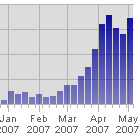
We have had 140,000 hits in April

statsgraph

Our web presence continues to grow and with our advertising campaign starting on Monday the 7th May we expect this to significantly increase. There are so many advantages to registering on Work Connexions that it is impossible to list them here. Key amongst them are increased exposure, consistent marketing with Google, newsletters, online marketing campaign and the radio. If you register you can link your site or project with us. Search engines regularly visit our servers imporving your visibility and ultimately, your business. Registration is Free.

How do you blog when you sell uninteresting products?

As the title of the blog suggests this is a rather unusual question. I am sure that there are many bloggers out there who would tell you not to even begin. Well I am not sure that I agree. In fact when I read a lot of the “How To Make Money Online” blogs, I felt that they do not have anything to sell. Of course this is an illusion, as they are they are selling what they are seeking and they are doing this with nothing more then their own desire to make money. There are hundreds of money making blogs out there. I am sure there are just as many toilet roll companies. If the money making blog can successfully sustain interest in their topic then the question is how does the toilet roll company, when intrinsically there is nothing of great interest in their product.

An answer to this question is simply that they talk about how they are selling their product. Just the same as for example a money making blog……

Independent Consultant

There comes a time in every business, whether it’s just starting up or has been going for many years when the decision makers are too close to see what is going on. It is a natural process. As owner of your company you are concerned with all aspects and thus cannot give individual time to certain areas or they just get left to one side. An independent consultant, whether that be in IT, human resource, or marketing can do these things. They can often very quickly get to the root of the problem. Because they are outsiders to your organisation and you are paying them, they know that they have to produce results. The only way to produce results is to tackle the problem.

A couple of very interesting links from Seth Godins blog today.

http://noonebelongsheremorethanyou.com this one is about website design

http://www.jott.com/Default.aspx and this could be the next mobile revolution

Here is one I found myself about starting up your own mobile phone friend network http://www.sonopia.com/mvc/network/main.html?html=/mvc/network/start.htm